Pillows · Sleep environment
Choosing a Feather Pillow: How Loft and Firmness Affect Comfort
A pillow can look inviting on a neatly made bed and still feel wrong at midnight. With feather pillows, the difference often comes down to a handful of quietly important details: how high the pillow sits, how firmly it resists pressure, how its fill is arranged, and whether it can be reshaped when your head moves.
Published October 13, 2026
Feather pillows have a distinct appeal. They can be molded into a supportive shape, pressed flatter when a lower profile feels better, then fluffed back into place. Their structure often feels more defined than the airy softness associated with down alone. But “feather pillow” is not a single, uniform experience. Fill composition, chamber design, pillow dimensions, shell fabric, and the sleeper’s position all affect how a pillow behaves once it is under the head.
That makes the shopping question less about identifying one universally best feather pillow and more about finding the right relationship between height and resistance. Loft is the pillow’s height when resting or being used; firmness is how much it pushes back as weight is applied. The two are related, but not interchangeable. A pillow can look lofty and compress easily, or appear low while feeling densely packed. Understanding the difference turns a confusing bedding aisle into a more practical decision.
What “loft” means in everyday use
Loft describes how much height a pillow provides. A high-loft pillow lifts the head farther from the mattress, while a low-loft pillow keeps it closer to the bed. Yet the height measured on an unused pillow is only a starting point. Feather fill shifts under pressure, so the effective loft is the height that remains after the head settles in.
That distinction matters because the goal is not to keep the head as high as possible. It is to support a comfortable, relatively neutral line through the head and neck. If a pillow collapses too much, a sleeper may feel as though the mattress is doing all the work. If it stays too tall, the head can be pushed into an uncomfortable angle. The sensation is personal, and mattress firmness, shoulder width, body shape, and habitual position can all change the amount of height that feels right.
Feathers have quills and a more structured feel than the fine clusters found in down. That structure can help a pillow feel substantial and moldable, but it does not guarantee that it will hold a fixed height. A feather fill may settle or compress during the night. The pillow’s construction and fill quantity influence how much it gives, and regular reshaping can be part of using it comfortably.
Firmness is resistance, not a synonym for height
Firmness describes the feel under pressure: how readily a pillow yields, and how much support remains when it does. A soft pillow may compress substantially, while a firmer one may retain more of its form. But firmness labels are not standardized across every maker, and two pillows marked “medium” can feel quite different in practice. Fill amount, fill type, shell, stitching, and internal compartments all contribute.
A pillow’s loft and firmness should therefore be considered together. Imagine two pillows with a similar height on the bed. One is lightly filled and compresses quickly; the other has a denser core and feels more resistant. Their starting profiles may look alike, but their support beneath the head can differ. Conversely, a lofty pillow may be soft enough to settle into a much lower profile once weight is applied.
For a useful comparison, notice not only how high a pillow appears, but how it responds when pressed and how easily it returns to shape. Does it spring back, remain dented, or shift its fill toward the edges? Does it feel supportive without forcing the head upward? These observations are more informative than height alone.
Match the pillow to your sleeping position
Sleep position offers a practical first filter, not a strict rule. People change positions during the night, and personal comfort can override a general guideline. Still, thinking about the space between the head and mattress can help narrow the options.
Side sleepers: consider the space at the shoulder
When sleeping on the side, the shoulder creates a gap between the head and the mattress. A pillow with enough loft and resilience to occupy that space may feel more comfortable than one that collapses immediately. The right amount depends partly on shoulder width and mattress softness: a broad shoulder or a mattress that lets the shoulder sink less may call for a different effective height than a narrow shoulder or a more yielding mattress.
More loft is not automatically better. If the pillow is too tall or too firm, it may push the head upward rather than simply filling the gap. If it is too low, the head may tip toward the mattress. A side sleeper can look for a pillow that feels adjustable and retains enough fill beneath the head after compression. Molding the fill before settling in may help, but the pillow should not require constant wrestling to remain comfortable.
Back sleepers: aim for a moderate, settled profile
Back sleepers often prefer a pillow that supports the natural curve of the neck without lifting the head excessively. A medium or lower effective loft may suit some people, though there is no single height that works for every back sleeper. A pillow that begins fluffy but compresses into a modest profile can feel different from one that stays tall throughout the night.
Pay attention to what happens after the pillow settles. If the chin feels nudged toward the chest, the pillow may be too high or resistant for that sleeper. If the head seems to drop back without support, it may be too low or too compressible. These are comfort cues, not a diagnosis. Persistent pain, numbness, or other symptoms deserve guidance from a qualified health professional rather than a bedding adjustment alone.
Stomach sleepers: lower can be more comfortable
Stomach sleepers generally have less room between the head and mattress, so a lower, more compressible pillow may feel less intrusive. A high pillow can turn the head or lift it at an angle that some sleepers find uncomfortable. Feather fill can be reshaped and flattened, which is useful for people who want to reduce height rather than add it.
Some stomach sleepers use little or no pillow beneath the head; others prefer a thin layer of cushioning. The best test is how the position feels over time, not how full the pillow looks when plumped. If a pillow is meant to be flattened every night to a fraction of its original height, that may be a sign to look for a naturally lower-profile option.
Fill composition changes the feel
Feather, down, and blended fills are often grouped together in conversation, but they do not feel identical. Feathers tend to bring more structure and a firmer, more defined response. Down clusters are softer and can create airy loft. Blends combine characteristics, with their overall feel depending on the proportions and how the fill is arranged inside the pillow.
Labels can help explain what is inside, but they should be read alongside construction details. A pillow containing both feather and down might have a feather-rich central chamber for stability, with down in outer layers for softness. That arrangement aims to offer a more cushioned surface while retaining a supportive core. A single-compartment pillow, by contrast, may feel more uniform, although its performance still depends on fill quantity and design.
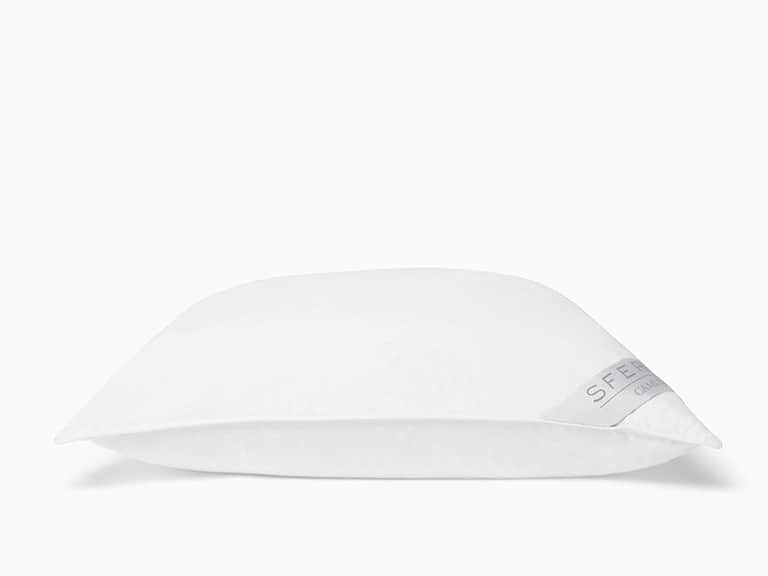
One example of a layered approach is the Camden Pillow. Its dual-chamber construction combines an inner core of feather and down with an outer layer of white down. This is relevant to shoppers who want to compare a defined center with a softer surface, rather than choosing between an entirely feather-filled or entirely down-filled feel. Its listed care instructions call for a gentle cold wash without an agitator, followed by low-heat drying with tennis balls to help maintain the fill’s distribution. Always check the manufacturer’s current care label before washing any pillow.
Construction can be as important as the filling
Two pillows with similar materials may behave differently because their interiors are built differently. Compartments can limit how far fill moves, while a gusseted edge can help a pillow maintain a more defined profile. Stitching and seams shape the pillow’s outline. A tightly woven shell helps contain the fill; its fabric also affects how the pillow feels against the face and how air moves through it.
Chambered designs are worth considering if a pillow tends to feel too soft at the surface or too unstable as the fill shifts. A supportive core can create a steadier base, while softer outer fill offers a gentler first impression. That layered feel is not for everyone: some sleepers prefer the uniform, easy-to-scrunch character of a single fill. The point is to treat construction as a comfort feature, not merely a technical specification.
Size also matters. A larger pillow can offer more area to reposition on, but it may not provide more useful support directly beneath the head. Likewise, a decorative pillow insert is designed primarily to fill a cover and contribute shape; it should not be assumed to work like a sleep pillow. Choose a pillow intended for sleeping when the task is nightly head and neck support.
A simple way to compare pillows
When comparing options in person, give each pillow the same brief assessment. Lay it on a surface similar to your mattress if possible, then press the center with a hand. Notice how far it compresses and how quickly it rebounds. Next, lie down in your usual position. A pillow that feels impressive in the hand may feel too tall once it is beneath the head; one that seems modest on a shelf may provide enough support after it settles.
- Check effective loft: Judge the height after the fill has compressed, not only when the pillow is freshly fluffed.
- Notice resistance: Consider whether the pillow yields gently or pushes back more firmly.
- Try your usual position: A side sleeper, back sleeper, and stomach sleeper may experience the same pillow very differently.
- Test reshaping: See whether the fill can be moved into a stable, comfortable form without excessive effort.
- Read construction details: Look for chambers, gussets, shell fabric, and care instructions, not just a broad firmness label.
- Check the return policy: A brief in-store test cannot fully reproduce a night of sleep; clear trial terms may matter.
If shopping online, look for specific descriptions of fill percentages, firmness options, pillow dimensions, and construction. “Plush,” “supportive,” and “luxurious” are impressions, not precise measurements. A detailed description can help you understand what the words are meant to convey, but it cannot guarantee that a pillow will feel right to you. Where possible, use return terms and care requirements as part of the decision.
The shell, temperature, and care routine
The outer fabric is in close contact with the face and can influence the overall experience. Cotton shells are common, but weave, density, and finish vary. A tightly woven shell can help keep fill contained, while a lighter, breathable fabric may feel less substantial. People sensitive to textures may want to consider the hand of the fabric as carefully as the fill itself.
Temperature comfort is shaped by the whole sleep environment: room conditions, bedding layers, personal preference, and the pillow. Neither feathers nor down guarantee a cool night. The way a pillow holds warmth will depend on its fill, shell, density, and airflow, as well as the sleeper. If you tend to feel warm, pay attention to whether the pillow feels stuffy during a trial and consider pairing it with breathable pillowcases and bedding.
Care is not an afterthought. A washable pillow may be appealing, but washing a feather or down-filled item incorrectly can leave the fill clumped or incompletely dry. Follow the specific care label rather than assuming every natural-fill pillow can be treated the same way. Some designs call for a professional cleaner; others permit careful machine washing under particular conditions. A washable protector can reduce everyday soil and may help limit how often the pillow itself needs cleaning.
When a pillow is approved for home laundering, drying deserves special attention. Fill that remains damp can clump and lose its loft. Follow the stated temperature and machine guidance, and make sure the interior is thoroughly dry before putting the pillow back into use. Do not rely on the outer fabric feeling dry as proof that the center is dry too.
Common mistakes to avoid
The first mistake is choosing by appearance. A tall, cloudlike pillow can be visually appealing but may not suit the sleeper’s position or preference. The second is treating firmness as a measure of quality. A firm pillow is not inherently better than a soft one; the useful question is whether its resistance and remaining loft feel comfortable for the person using it.
Another common mistake is assuming that a pillow’s fill percentage tells the entire story. Composition matters, but construction and fill weight affect how that mixture behaves. A feather-and-down blend with a layered interior can have a different feel from the same materials mixed uniformly. Ask how the fill is arranged and whether the pillow is designed to be reshaped.
Finally, do not expect a pillow alone to solve every sleep problem. Comfort is influenced by the mattress, sleeping position, bedroom temperature, noise, and other factors. If discomfort persists, changing pillow loft may be one reasonable experiment, but ongoing or severe symptoms should be discussed with a health professional.
A better choice starts with your own comfort cues
The best feather pillow is not necessarily the softest, firmest, or most expensive. It is the one whose loft remains comfortable under your head, whose firmness feels supportive rather than forceful, and whose shape can be adjusted to suit the way you sleep. Side sleepers can begin by thinking about shoulder space; back sleepers can assess whether the pillow settles without pushing the head forward; stomach sleepers may prefer a low profile that can be flattened easily.
Then look beyond the label. Consider the fill blend, chamber design, shell, care requirements, and whether the pillow’s behavior matches your expectations. A feather pillow’s ability to be molded is part of its character, but that flexibility should make comfort easier—not turn bedtime into a nightly reshaping project.
In the end, loft and firmness are not abstract specifications. They are the felt distance between your head and the mattress, and the small measure of resistance that remains through the night. Start with your position, test how a pillow compresses, and give greater weight to your own comfort than to a universal ranking. That is a more dependable route to a pillow that belongs in your sleep setup.